On-Demand Webinar
Winning Complex Healthcare Deals
Don't have time to watch the full recording? Here's the TLDR;
- Healthcare buying decisions begin before most sellers can see them.
- Buying momentum appears when related research, direct engagement, business events, and stakeholder activity reinforce one another.
- The advantage comes from connecting those signals to a coordinated response across marketing, sales, executives, and subject-matter experts.
Questions received during the live session
What do organizations most often get wrong when choosing signals and deciding how to score them?
The biggest mistake is treating signal selection as a marketing-only exercise. Marketing, sales, and operations may value very different behaviors. A signal that seems important in theory may not be the behavior your sellers have learned to associate with an active evaluation.
Organizations also tend to weight too many signals equally. Broad topic research, competitor activity, a pricing-page visit, and repeated case-study engagement do not carry the same meaning. Scoring should reflect the patterns that have preceded real opportunities, including the stakeholder involved, the stage implied by the content, and relevant context such as installed technology or a renewal window.
Start by asking your sellers what makes them believe an RFP or buying process is approaching, then validate and refine those assumptions with actual opportunity data.
How should first-party engagement and third-party intent be weighted?
Third-party intent is most useful for identifying accounts that may be entering the market and giving marketing a broader group to monitor or engage. Because the signal can be anonymous and varies in strength, it should generally carry less weight by itself.
First-party engagement usually deserves more weight because it shows that an account is interacting directly with your solution, proof, or value story. Engagement with case studies, solution pages, ROI content, pricing, integration, or implementation materials can be especially meaningful when it comes from relevant members of the buying group.
The strongest score combines the two: third-party research identifies potential demand, while first-party and multi-contact engagement provide stronger evidence that the account is progressing. The numerical example shared in the webinar was illustrative, not a universal scoring formula; every organization should calibrate weights to its own sales motion and evidence.
If an organization's data is fragmented, what is the most practical way to get the first use case moving?
Do not wait for a perfectly unified data foundation. Data is always changing, and waiting for perfection can prevent teams from learning through action.
Choose one solution or play that already has organizational focus, relevant website content, and planned campaigns or events. Define the small set of signals needed for that use case, align the team on how marketing will create engagement, what sales should watch for and how they should respond, and which subject-matter experts may be needed.
Measure whether the pilot creates opportunities, pipeline progression, or revenue. A visible success story builds confidence and gives the organization a reusable framework that can be expanded to another solution, segment, or business unit.
Where do organizations struggle most when operationalizing this approach across marketing, sales, and subject-matter experts?
The most common barrier is incomplete commitment across the go-to-market team. If marketing builds the system but sales, operations, or subject-matter experts do not share accountability for it, execution will break at the handoff.
Successful organizations establish leadership sponsorship, agree on the target buying group and thresholds, assign ownership for every step, and hold teams accountable for following the play. Marketing may initiate the approach, but a committed sales or subject-matter counterpart is often essential for validating the signals, improving the messaging, and mobilizing the broader team.
This is the essence of Revenue Orchestration: connecting signals, decision rules, team ownership, coordinated action, and measurement in one operating discipline.
How does this process address incrementality? How do we know marketing contributed to a successful outcome?
Intent data does not resolve incrementality by itself. It helps identify which accounts may be active and where marketing and sales should focus. The incrementality question is whether the actions taken in response to those signals changed the outcome.
To understand that contribution, organizations need an account-level view that connects intent and engagement signals with marketing activity, sales interactions, opportunity progression, and revenue over time. Across a sufficient number of accounts, measurement models can estimate whether marketing increased the likelihood, speed, or value of successful outcomes while avoiding duplicate credit across channels and teams.
That distinction is important in ABM. An account should not be counted as a marketing success simply because it showed intent, received marketing, and later purchased. Some of that demand may have existed already. The goal is to separate that existing demand from the additional contribution made by marketing and the coordinated ABM play.
It may not be credible to assign marketing an exact share of one complex healthcare deal. The more defensible approach is to estimate marketing’s incremental contribution across a larger group of accounts.
For more on Marketbridge’s account-level approach, see A Better Way to Measure and Communicate B2B Marketing ROI.
How should signals inform prioritization when buyers may not speak with sales until they have formed their shortlist?
Buying readiness and sales readiness are not necessarily the same. An organization may be actively evaluating options while still preferring to conduct its research independently.
That makes early signals valuable, but they should not automatically trigger sales outreach. Early activity might prompt more relevant educational content, clinical or economic evidence, peer examples, or engagement tailored to different buying-group roles. As the pattern becomes stronger, the response can shift toward deeper guidance and more direct interaction.
The purpose of recognizing momentum early is not simply to accelerate a sales conversation. It is to help the organization earn a place on the shortlist while the buyer is still defining the problem and evaluating possible approaches. A strong signal should trigger the right play, not necessarily a sales call.
From a Marketbridge perspective, signals should do more than indicate interest. They should guide what happens next. The Anatomy of a Signal Driven GTM System explores how signals can inform the message, motion, timing, and appropriate level of human involvement.
Are signals primarily dependent on digital activity and frontline sales? How can organizations source reliable information without creating friction in how prospects conduct research?
Digital behavior and frontline sales intelligence are important inputs, but neither should represent the entire signal system.
Organizations can combine first-party engagement, third-party research, CRM history, sales and partner observations, business events, customer feedback, and eventual pipeline or revenue outcomes. Reliability comes from connecting these sources at the account level, applying consistent definitions, and testing whether the patterns actually predict progression.
No single input should carry too much weight. An anonymous website visit or an unverified sales observation is weak evidence by itself. A change from the account’s normal activity, engagement from several relevant roles, and a business event that explains why the organization may act create a more credible pattern.
The response should also respect how buyers want to research. A signal can prompt better content, broader account coverage, or a change in message without triggering immediate outreach. The objective is to make engagement more relevant, not to make buyers feel that every action is being monitored.
For more guidance on evaluating and acting on different signals, see Demandbase’s Real-Time Buying Signals: 20+ Examples for GTM Teams.
How do you distinguish an active buying process from healthcare professionals who are simply staying informed?
No single signal can make that distinction with certainty. The goal is to improve the probability of recognizing an active evaluation by looking for movement, not merely activity.
Someone staying informed may periodically consume broad educational content without any meaningful change in behavior. A potential buying pattern is more likely to include deeper engagement, participation from additional stakeholders, movement toward solution, economic, or implementation content, increased activity within a compressed period, and a business event that explains why action may be needed.
The account’s historical baseline also matters. Ten visits to the same introductory page may be less meaningful than a sudden progression from broad research to clinical evidence, integration requirements, and economic justification across several stakeholders.
These patterns should then be validated against actual outcomes. If a supposedly high-intent pattern rarely becomes a qualified opportunity, its scoring should be reduced. Until the buyer or sales team provides further validation, the account should be treated as a probability rather than reported as pipeline.
Demandbase explores how sustained research, topic specificity, and changes from an account’s normal baseline can help distinguish general interest from an emerging purchase cycle in Get in Front of the Competition: Use Intent Data to Find the Accounts That Drive Your Business.
Healthcare B2B Buying Momentum Is a Pattern, Not a Single Signal
Healthcare buying momentum is not revealed by a single signal, but by patterns of behavior across multiple stakeholders, channels, and stages of evaluation. This article explains how healthcare organizations can connect these signals with business context and use Revenue Orchestration to coordinate timely, relevant action across marketing, sales, and subject matter experts.
What Does Buying Momentum Look Like in Your Market?
Buying momentum rarely appears as one obvious action. Select your market to see how first-party engagement, third-party intelligence, and business events can come together to reveal a decision in progress.
- Payers
- Health Tech
- Med Tech
-
Payers
Spot an Employer Benefits Review Before the RFP
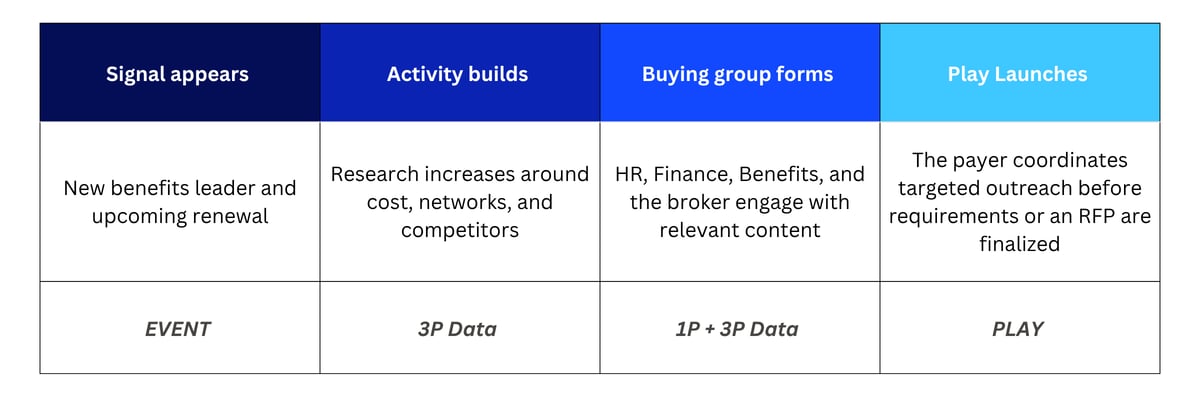
Signals to watch
First-party signals
- Multiple Benefits, HR, Finance, procurement or broker contacts from the same account engage
- Account engagement expands across plan, network, cost and value-proof content
- Previously inactive stakeholders return or engagement accelerates within a short period
- Known renewal timing aligns with increased account or broker engagement
- A broker requests information on behalf of an employer
Third-party intent signals
- Account-level research increases around health-plan costs, funding models or network strategy
- Research expands from general benefits topics to plan alternatives and vendor comparisons
- Multiple stakeholders from the account demonstrate relevant research activity
- Engagement with industry publications or comparison content increases
Business events
- New Benefits, HR or Finance leader
- Approaching renewal or benefits-planning window
- Acquisition, divestiture or geographic expansion
- Material workforce growth, reduction or composition change
- Restructuring or a newly announced cost-reduction mandate
- Broker-of-record change, when that information is available
What the payer could do
Launch coordinated, role-specific outreach before an RFP or quote request emerges: provide Benefits with plan-design guidance, Finance with an economic comparison, and the broker with relevant market and performance proof.
-
Health Tech
Recognize When a Technology Evaluation Is Forming
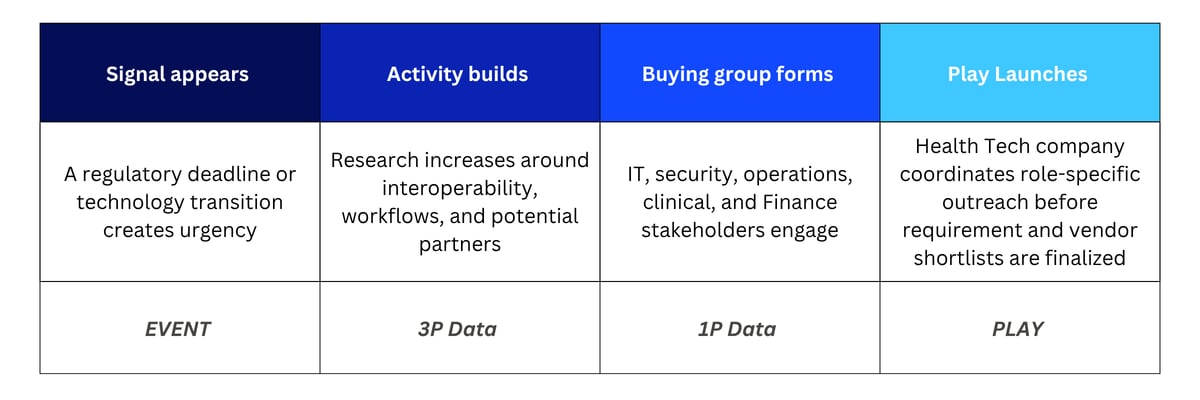
Signals to watch
First-party signals
- Multiple clinical, operations, IT/security, Finance or procurement contacts from the same account engage
- Engagement expands from thought leadership to solution, integration, security, ROI or implementation content
- Multiple stakeholders engage with different content tied to the same underlying need
- Event participation is followed by relevant website activity, content consumption or a response to outreach
Third-party intent signals
- Account-level research increases around the workflow problem, solution category or competitors
- Research expands from a broad business issue to integration, security and implementation requirements
- Technographic data reveals an incumbent platform, aging technology or likely migration window
- Relevant partner, consultant or industry activity suggests an evaluation may be developing
Business events
- New CIO, CDIO, CISO, COO or transformation leader
- EHR migration, platform consolidation or cloud transformation
- New funding, capital investment or transformation initiative
- Cybersecurity remediation initiative
- CMS, ONC or other relevant compliance deadline
- Job postings tied to interoperability, AI, cybersecurity, analytics or transformation
What the Health Tech company could do
Equip IT with an integration brief, security with relevant risk documentation, operations and clinical leaders with a workflow assessment, and Finance with an economic model—then offer a cross-functional readiness session before requirements are finalized.
-
Med Tech
See When Clinical Need and Capital Timing Converge
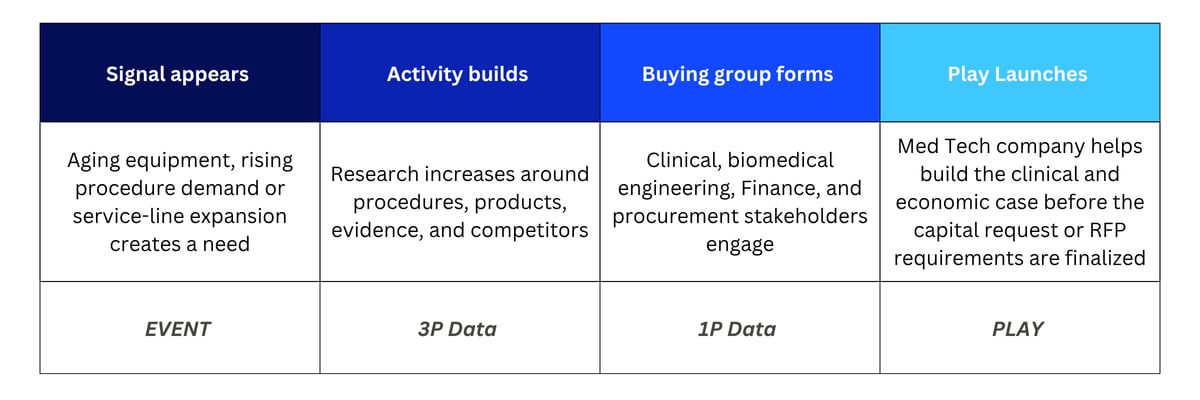
Signals to watch
First-party signals
- Multiple clinical, biomedical engineering, IT, Finance, supply chain or procurement contacts from the same account engage
- Engagement expands from clinical evidence to product comparisons and economic value
- Stakeholders engage with reimbursement, integration, implementation, service or maintenance content
- The account requests a demonstration, product evaluation, site visit or budgetary estimate
Third-party intent signals
- Account-level research increases around a procedure, product category, competitor or clinical evidence
- Competitive installed-base intelligence indicates equipment age, lease timing or end-of-life risk
- Research progresses from a clinical need to product, implementation and economic considerations
- Relevant GPO, reimbursement or coverage activity affects the product category
Business events
- New clinical, service-line or supply chain leader
- New facility, procedure program or service-line expansion
- Capital allocation, grant award or announced modernization initiative
- Rising procedure volumes or changes in patient demand
- Competitor recall, shortage, safety notice or product discontinuation
- Regulatory approval or reimbursement change affecting the category
What the Med Tech company could do
Equip clinicians with outcomes evidence, biomedical engineering with technical and service requirements, Finance with a total-cost model, and procurement with contracting and implementation guidance—supported by a coordinated demonstration, peer reference or value-analysis session.
A Signal Is a Clue.
A Pattern Is Buying Momentum.
Third-party signals help identify accounts to watch. First-party engagement shows what buyers need from you. Business events help explain why an organization may need to act now.
The opportunity comes from recognizing when those signals reinforce one another—and coordinating the right response across the buying group.
Schedule a strategy session with Marketbridge and Demandbase and discover which buying signals you need to be seeing earlier.
.png?width=400&height=50&name=x%20(7).png)